Showing posts with label NCAA. Show all posts

Friday, March 20, 2015

And Then There Were None (NCAA)


Day one of March Madness is in the books. Upsets, upsets, upsets! These three words pretty much sum up what transpired on yesterday for Texas teams in the NCAA Tournament.

Click to enlarge
If you weren't aware, there are actually 0 teams representing the state of Texas in March Madness right now. I anticipated the losses of Texas Southern and Stephen F. Austin (mainly because SFA is my alum's rival). Oh, and Texas since I predicted UT getting sent home in the 3rd round. However,  I cannot say the same for Baylor and SMU.

Judging from my bracket below, you can see I was a victim of "Texas bias". Baylor AND SMU making it to the Elite Eight?! Yea, I guess you can say I had high hopes.

It was unfortunate that both teams fell to underdog opponents. I can only imagine how long the bus/airplane ride back home feels. However, these teams should be back in the tourney next year. SMU lost a few starters and managed to win their conference this past year. I look forward to the Mustangs readjusting and making a lengthier run in the 2016 tourney.

Click to enlarge
Fans of the Bears have a lot of positives going into next season, mainly because they're only losing two seniors. Baylor has always been a tough competitor. Plus, there will be a chip on their shoulder as they look for redemption in 2016.

Let's just be thankful I didn't predict one of those Texas teams to win it all.

So far, I have four brackets in total (three on ESPN Tourney Challenge; one on CBS Sports that you see below).

Surprisingly, I was sold on the idea of Kentucky (and even Duke) winning the championship. But I have a good feeling that Wisconsin may be the team to surprise everyone.

At the end of the day, it's March Madness. Anything can happen (like the goal-tending call on SMU

Follow this blog on Twitter: @214_Manuscript

Wednesday, December 3, 2014

Does TCU Deserve to be Ranked over Baylor? (College Football)

The Horned Frogs have earned the spot as of now according to the College Football Playoff  Selection Committee, but do they really deserve to play in the semifinal with a loss to Baylor on its résumé?

I was recently posed this question following the Selection Committee's recent rankings and thought it would be a good idea to post my answer on here. Before I begin, I love Baylor and TCU but the numbers do not lie. In my opinion, rank should be based upon more than an overall record, such as strength of schedule and the way teams performed in wins and losses.

Well, let's begin:

TCU has a better record against common opponents:

The beauty of the current Big 12 setup is that each team plays every other team, so when comparing résumés between Big 12 teams, you get plenty of chances to compare performances.
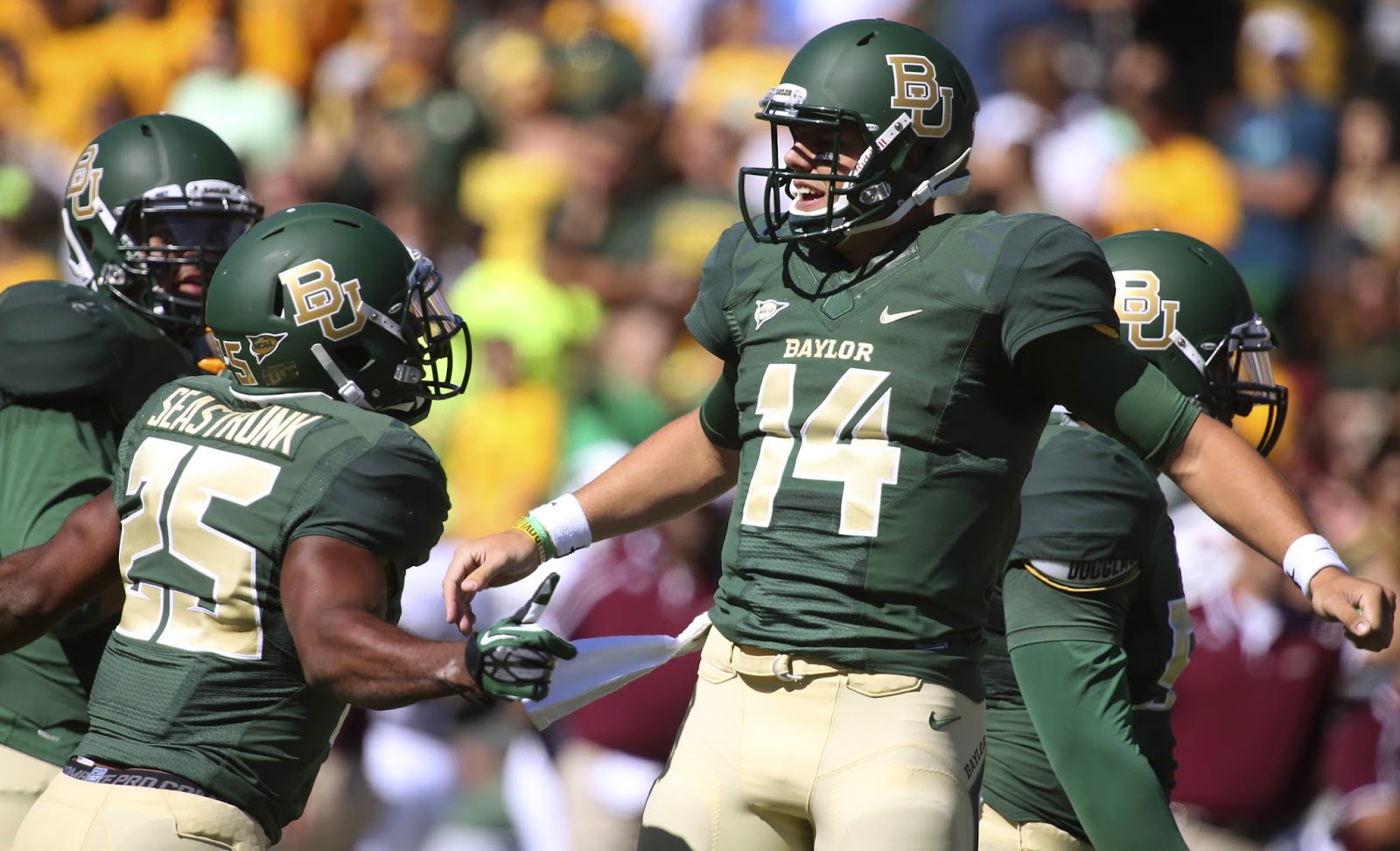
Thus far, TCU and Baylor have both played Oklahoma and West Virginia. Both teams got the best of the Sooners, but in different ways. TCU played an undefeated, full-strength Sooners squad at home and held on to a small lead late at home. Baylor played Oklahoma without its best receiver, dominating the Sooners in Norman. The Bears might have the advantage there, but the games against West Virginia may be a better comparison. Both teams had to go to Morgantown, but only TCU was able to come away with a victory on the road, winning on a last-second field goal. The Bears were held from doing much against WVU in a 41-27 loss.

TCU’s loss to Baylor is better than Baylor’s loss to West Virginia:

While Baylor has the head-to-head battle on TCU, that loss is probably the best loss on any résumé in the country. If you look at it as any random opponent and not a head-to-head matchup, TCU led for the better part of three quarters over its opponent, mostly dominating while on the road. That loss was a result of one bad quarter and came against a top 10 opponent. Baylor’s loss, regardless of what TCU did against West Virginia, came to a team that has three losses this season in a game in which Baylor never seemed to have a chance to win after halftime. If you take the head-to-head element out of it, TCU’s loss is much more understandable and forgivable than Baylor’s.

TCU has a tougher out-of-conference schedule:

The schedules for these teams match up pretty well for a side-by-side comparison. Both play a full nine-game Big 12 schedule against all the same teams. They each convincingly beat an FCS opponent, with TCU beating Samford 48-14 while Baylor beat Northwestern state 70-6. Both teams had fun beating up SMU, as TCU won in Dallas 56-0 while the Bears opened McLane Stadium with a 45-0 thrashing of the Mustangs.

The difference in schedule comes in that last game. The Horned Frogs scheduled a home-and-home with Jerry Kill’s Minnesota program that started in Fort Worth this year and heads north in 2015. TCU didn’t have much trouble in that one, shutting down the Golden Gophers in a 30-7 game in which Minnesota didn’t get on the board until the fourth quarter. The Gophers have only made that TCU win look better as the season continues by contending in the Big Ten West and compiling a 7-2 record thus far. Baylor’s answer? The Bears hit the road for a Friday night matchup with Buffalo. The MAC (Mid-American Conference) team brought its best, but fell to Baylor 63-21. The Bulls are a weak 5-6 this season and will need to win its final game to become bowl eligible. These wins just don’t compare, and rewarding Baylor for scheduling cake walks is not a good precedent for the committee to set in the first year of this system.

Thursday, August 14, 2014

Should Only Conference Champions Play for the Title?

Should only conference champions qualify for the College Football Playoff?

Since its early beginnings, college football has thrived upon the aspect of regional competition. The schools in their respective regions would form a conference and compete against one another, ultimately crowning the champion of the region "Conference Champions." Following those regional championships, various polls (Associated Press and Coaches' Poll, etc.) would rank the national champion; but, there would be no doubt who was the best locally.

Winning the region mattered more than winning nationally most of the time. Longhorn fans mainly wanted to beat Texas A&M and Oklahoma every year (and vice versa), enthusiastically placing non-conference and sub-par conference teams in the losing column. Just imagine how Alabama fans in the SEC (Roll Tide!) measure the Crimson Tide's success rate, such as basing a "successful" season on if they beat Auburn or LSU. College football is serious, but conference play is even more serious.

With the conference title, your team earns bragging rights for the rest of the year...which is wayyyy more important than a national championship, right? Or, it used to be.

Well, the trend of NCAA National Champions has been very consistent in catering to SEC dominance. In the past 10 years, 9 of those championships have featured a school from the SEC (Southeastern Conference). I'm focusing on this conference because its conference champion (and even runner-up) has almost always been represented in the national championship.

This is why conference play has been so important to college fans, players, and coaches. Win the conference and you have a better shot at vying for the #1 or #2 spot. As for those 3rd place finishers, their consolation prize may be the toughest pill to swallow (playing for 3rd place)...especially those who may finish the season undefeated.

Will the College Football Playoff provide the necessary solution for the issue of "conference favoritism"?


The College Football Playoff has established a selection committee who pick the best teams fit for competition, which means the AP Top 25 Poll and USA Today Coaches Poll mean absolutely nothing.

All we can do is hope the selection committee will bring integrity and a non-bias culture to the college football postseason. Of course, this 13-member committee includes people with ties to different schools but they will not be able to vote for their respective schools in order to remove any bias.

This can be a step in the right direction for college football. Even though four teams will be selected by the committee, there will always be a team who gets the short end of the stick (5th place finisher).